Showing posts with label 2012. Show all posts

Tuesday, January 1, 2013

Through the Years - Number Ones

I'm scheduling this post out for January 1, 2013. If it actually posts and there's anyone around to read it, that means we made it. There was no Mayan Apocalypse. The end of the Mayan calendar was just because the poor calendar maker had to stop somewhere. He was pretty tired.

Anyway, I started this blog in 2009 as an offshoot of my activity on Shelfari. But I'd joined Shelfari to save my sanity back in 2006, right after I'd graduated from college. I've been keeping track of my number one favorite reads from each year since then. Here they are:

2006 - Jude the Obscure (Signet Classics)

2007 - Jane Eyre (Dover Thrift Editions)
Jane Eyre is your first rate super heroine. I loved this book. It seems before its time in the way that Jane never compromises herself. She stays true to who she is and doesn't let circumstances, people, or religion, dictate her life. I definitely was not expecting this to be as good as it is, and breezed through it very quickly. 
2008 - The Amazing Adventures of Kavalier & Clay
I loved this book from beginning to end. I have so many things to say, but nothing quite grasps just how good this was. Kavalier & Clay will stay with me for a long time. Absolutely beautiful. Funny in a way that you must sometimes laugh in the hands that life deals you. True in spirit. Amazing.  
2009 - The Shining
Loved, loved, loved. I recently became obsessed with the movie, thinking it incredibly amazing. Beyond a horror story, the study of the human character. And the nature of evil. And god, Jack on that staircase and Wendy with the bat. I could watch that scene over and over. Anyway, I've never (except for when I was in middle school reading R.L. Stine and realize that his books were too juvenile for me) had the desire to read King, but the word from everyone was: If you liked the movie, you'll love the book.
The book was, as it often is, so much better. I've a respect for King I never thought I'd have. Though, you can't truly say that until you try. What a fantastic writer! This man knows where it's at. The book was absolutely amazing, much more than a horror story, with it's exploration of familial relationships and the essence of evil. 
2010 - Raven: The Untold Story of the Rev. Jim Jones and His People
Wow.
Raven is the story of Jim Jones and the People's Temple - told by Tim Reiterman, a journalist who survived the massacre of the Ryan party in Guyana just hours before more than 900 People's Temple members committed "revolutionary" suicide with poisoned Grape-Aid. Reiterman begins at the beginning - the birth and early life of Jim Jones and moves carefully forward, in almost 600 pages, to chronicle the rise and fall of a people who put their lives in the hands of a sociopath. 
2011 - Geek Love: A Novel
Not at all what its title implies - even when you find out exactly what Katherine Dunn means by Geek. Should have been called Freak Love, but I think the mystery and the - "Oh my god, this isn't about two nerds falling in love?" is half the attraction.
Concerning a traveling carnival whose acts were bred instead of hired - the story is told by Olympia Binewski, a bald, albino, hunchback dwarf and the youngest daughter of Lil and Al Binewski. 

2012 - Last Call: The Rise and Fall of Prohibition
Last Call is  intelligentthorough,and fun. The book had me researching and discussing a topic I hadn't given much thought of before. 

Thursday, December 20, 2012

Top 10(ish) of 2012 (& See Ya Later?)

I've slowed down considerably at the end of this year, and I'm not sure why. Other interests and activities - a lot of crocheting, letterboxing, hiking, and watching of both Bones & Buffy via Netflix. I haven't felt like reading a GD thing since deciding to not finish the terrible Casual Vacancy, which means I didn't at all meet my goal of 44 novels - reaching only 31. Still - I read some quality literature this year and it doesn't all fit neatly into a Top 10.

Top 7 5-Star Reviews

7. Gone Girl - Gillian Flynn
6. Wonderstruck - Brian Selznick
5. Inside Out & Back Again - Thanhha Lai
4. We Need to Talk About Kevin - Lionel Shriver (and about Adam Lanza)
3. The Climb - Anatoli Boukreev
2. Into Thin Air - Jon Krakauer 
1. Last Call: The Rise and Fall of Prohibition - Daniel Okrent

I really love it when my favorite books of the year are non-fiction titles.

#s 8, 9, & 10

There are too many titles that fit the last few numbers on my list. Forced to choose by my own controlling nature, I'd go with:

10. Legend of a Suicide - David Vann
9. Hard-Boiled Wonderland and the End of the World - Haruki Murakami
8. The Left Hand of Darkness - Ursula K. LeGuin

However, the following titles are all just as incredible and could take the place of any of the above:

Green Hills of Africa - Ernest Hemingway
Kingdom Come - Mark Waid, Alex Ross
The Walking Dead - Robert Kirkman
Babbitt - Sinclair Lewis
The Postmortal - Drew Magary
Lump - Leena Luther

To finalize, I was sitting in my library and staring at my shelves and realized that I'd really like to spend a year reading with abandon. That means reading whatever I please without worrying about posting reviews or maintaining any lists. I've taken leave before and reserve my right to do it again - I'll be stepping away from this for a little while. Posting will be sporadic and few. I have a post set to go up at the end of the year, if we make it beyond the End of the World. Otherwise... radio silence.

Wednesday, November 14, 2012

The Casual Vacancy - J.K. Rowling


Rating: 1 star

It's so incredibly rare that I don't finish a book. For one, the sheer pain associated with reading an awful book makes me so mad, I don't want to have toiled so hard for a book I can't count among my yearly numbers. But oh god. Maybe you've noticed I've disappeared for a while. Over a month, I think, without a decent post, tweet or tumblr quote. Part of that is the volume of work I've had to deal with this Fall - our fiscal years don't align with the calendar year and so, September and October are busy, busy planning months. The other part of my silence was this new and godawful book by J.K. Rowling.

It took me the better part of two months to read a little over 100 pages. I finally made the decision to quit on Friday of last week, realizing I was wasting a lot of valuable reading time desperately trying to get through this novel just because J.K. Rowling wrote it.

My complaints mirror the complaints of the masses. Just Google it - you'll find more bad reviews than good ones. What gets me the most is that J.K. made a concentrated effort to have this marketed as an 'adult' novel - the Harry Potter author goes rogue, she can write what she wants, etc - and then reduced every single one of her adult characters (and there are so, so many) to mere caricatures. They might as well all have been named either Vernon or Petunia Dursley. And, surprisingly enough, the only characters with any depth at all are the teens. Unfortunately, their chapters can not carry the burden that is this book.

The book begins with Barry Fairbrother's death, a very well-written chapter that falsely draws you in to the terrible narrative that is to come. As soon as Barry hits the pavement, literally, the section titled Monday launches. In it, each character is given a chapter and a chance to react to the news of Barry Fairbrother's death. Sometimes more than once. Since Barry held a seat on the Parish Council in Pagford and was an instrumental player in the fight to keep The Fields (housing projects) a part of their well-to-do town, the reactions vary from distress to political plotting. And then Tuesday happens and, if you didn't guess it, I'll tell you - each character is given a chapter to talk some more about Barry Fairbrother's death, the reactions varying from distress to political plotting.

I couldn't. I'm sorry - I just couldn't. The plot crept along and the characters were utterly unlikable. J.K - how could you expect me to keep reading?

Wednesday, September 26, 2012

Gone Girl - Gillian Flynn


Rating: 5 stars

Listen. I'm aware of the fact that my reviews are somewhat lacking because I never took journalism classes because I never had the interest - even though when people hear reader and writer they immediately think you must have been on the school newspaper. There's a difference. A major difference in all the genres, all the nuances of reading and writing. Journalism is not my shtick. My reviews vary from those I'm super proud of, to those that kind of suck. My main goal, in all of my reviews, is to get to the heart of Did I like it? and Will you like? quickly - for those of us that maybe don't want to spend an hour reading a blog post just for the answer to those two questions.

That being said - I'm not entirely sure where to start with Gone Girl. Yes, I liked it. Loved it, in fact. Gillian Flynn can write. And yes, I think you'll like it, too. Just be prepared for a mind-f*ck beyond any you've ever had before.

Meet Nick and Amy, the unreliable main characters of Gone Girl, who we learn - via Nick's opening narrative - are celebrating their fifth wedding anniversary on the ominously titled "Day of." Day of... what, you ask? The day that Amy disappears, leaving behind a curiously staged crime scene and a diary that, interspersed with Nick's chapters, gives an eerie description of their marriage, oftentimes contradicting what Nick has only just disclosed the previous chapter. And just when you think the book is a classic whodunit, it morphs into a study of character, so intricately woven and perfectly written, you really aren't sure what the hell just happened to you, but you're kind of glad it did.

Review with Spoilers via FullStop (has all the words I don't).
Via The Millions - a discussion on Gillian Flynn and the distinctions of sex, class and identity in her novels. 
Book Magnet's Spoiler Free Review

Purchase Now from Amazon 

Friday, September 21, 2012

The Climb - Anatoli Boukreev


Rating: 5 stars

Despite the contrary opinions of most other reviewers, I exited Krakauer's Into Thin Air with a brave and stoic impression of Anatoli Boukreev. And it is true - the Anatoli Boukreev represented in Jon's novel is a less villian-y rendition of the Boukreev first represented in Krakauer's article for Outside, published shortly after the '96 Everest excursion. Still, the fear remained for Boukreev and many who knew him that Krakauer's telling of events ruined forever the reputation of an expert climber and hero.

The Climb is Anatoli Boukreev's - with the help of G. Weston DeWalt - version of the events surrounding the Everest tragedy. My first impression of the differences between both accounts was this: Krakauer is a hobby climber who writes extremely well; Boukreev is a professional, well established mountaineer. If Krakauer manages to give readers the emotional aspect of the mountain in '96, Boukreev gives the factual, the carefully considered, the professional view of everything that went wrong that summit day. And Krakauer kind of comes off like a petulant jerk.

Still - there's a pleading note to Boukreev's book that checks my desire to whole-heartedly believe one account over the other. It's as if Boukreev is begging us to see that he made no mistakes at all - that he alone may have had all the answers in avoiding what happened to the people on that mountain. Both books do seem to acknowledge, however, that a series of small mistakes and/or misunderstandings led to the loss of lives. Despite this, the fact remains that because Boukreev descended before the other climbers (as he is criticized for doing in Into Thin Air), he was definitely in a position to go later out into that storm and rescue three people, by himself.

It was very difficult for me to start this book just five months after completing Into Thin Air. Reading again the climbers hopes and expectations prior to reaching Everest, yet already fully knowing the outcome, knowing I was subjecting myself to those emotions again was hard. But I'm really glad I did. I'll never climb Everest but I can keep these people alive in my memory because of men like Krakauer and Boukreev who took the time to make this story known.

Further Reading: Letters from Krakauer, Boukreev & Lopsang

Purchase Now From Amazon

Monday, September 17, 2012

Moll Flanders - Daniel DeFoe


Rating: 3 stars

I struggle between not liking this book at all, and liking it a lot. There's much to say about DeFoe's structure, theme and characterization. And what it's lacking (any consequence whatsoever for Moll's many marriages, children and life of crime) helps to bring about DeFoe's main theme - the juxtaposition of Christian morality with ethics and the struggle to survive - which seems pretty heavy and scandalous for the time period.

I loved Robinson Crusoe and so had pretty high hopes for Moll Flanders. What Crusoe and Flanders have in common is their resourcefulness - their ability to make the best of the worst situations and come out not only alive, but better off than before. And even though Moll does this by manipulating many, many people and leaving scores of children behind - you can't help but pity her for the terrible situations that come of her many attempts of "meaning well," and kind of respect her for trying and succeeding in the end.

Purchase Now from Amazon

8/75

Wednesday, September 12, 2012

The Hobbit - J.R.R. Tolkien


Rating: 4 stars

I started reading this slowly, at the beginning of the year, in the hopes of savoring it until the movie arrived. I have to tell you, it started out all rainbows and nostalgia until someone told me that the movie was going to be split into three parts. I spent the remainder of the book angrily wondering how Peter Jackson planned to successfully pull that off without pissing off fans. It's a small book! Written as a young adult novel! Yes, there are many adventures along the road to the Lonely Mountain, but nothing that packs as much punch as the actual ending of the novel. There aren't any real clear starts and stops that - to my mind - make three separate, yet cohesive movies.

Anyway - film making aside - I first read this book when I was in middle school, so it's been a long, long time. Fifteen years, maybe? Perhaps a bit more. I was surprised by how many details have stuck with me over such a wide span of years. This time - knowing and loving Bilbo well, rather than having just been introduced to him - I was able to imagine that it was Bilbo himself writing the tale. The writing style is so vastly different from the Lord of the Rings trilogy that it isn't difficult at all to replace Tolkien's voice with Bilbo's. It's much more humorous and has the tone of a folk-tale - you can almost imagine Bilbo around a campfire, enacting his tale to a captive audience. Also - there's a lot less walking.

I'd say the 4-star rating of my memory holds up with my current reading of the novel. Middle-earth is a place I wouldn't mind continuing to visit time and time again.

Purchase Now from Amazon. 

7/75

Monday, September 10, 2012

Babbitt - Sinclair Lewis


Rating: 4 stars


While not always the most riveting of reads, Babbitt - a satire on the conformity and hypocrisy of the middle class - is incredibly well written and insightful.

George F. Babbitt is a middle class business man from Zenith, a fictional city located somewhere in middle America. He lives with his wife and three children in the suburbs of Zenith, in a house that looks much like the houses of his neighbors and that is furnished with all of the modern conveniences. He carries on his real-estate business like he is supposed to, attends all the right clubs (Booster, Athletic, Elk), attends church and throws dinner parties for his neighbors - all of whom, like Babbitt, spend their days attempting to climb the social ladder.

But when Babbitt's best and oldest friend gets arrested for eschewing these values, George begins to see his life in a new light. It all seems a fraud to him and so he tries his hardest to really live his life, with his own opinions and thoughts. In response, the good citizens of Zenith begin to shun him.

It isn't until Myra, Babbitt's wife, falls ill that he begins to realize the middle class world he's a part of is one that he helped create. And so, he falls somewhat comfortably back into it - yet, in the end, he tells his son Ted, "I've never done a single thing I've wanted to in my whole life! I don't know's I've accomplished anything anything except just get along." He encourages Ted to make his own way through life, following his dreams and damning those who would try and stop him, thus ending the book with a glimmer of hope for the next generation.

The book was surprisingly resonant, for having been published in 1922. Sure many things have changed, but the core of the novel focuses on a man just gliding through his life, doing everything he thinks he's supposed to do and nothing for himself. By the time he tries to regain that freedom, it's too late. I was fortunate that I knew what I wanted, worked hard to get there, and was supported by incredible parents who, I think, understand how unfulfilling a path you didn't necessarily want to take can be. But, moving through the corporate world, even if it's the precise world that I've chosen, does include its measure of conformity. We just call it "playing the game" now.

Purchase Now from Amazon. 

6/75

Monday, August 27, 2012

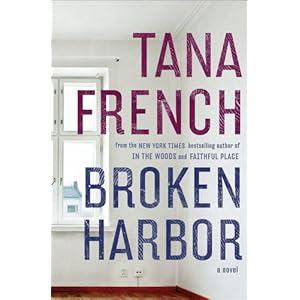
Broken Harbor - Tana French


Rating: 3 stars


While not quite on par with French's first three novels in the series, Broken Harbor still does not disappoint. It follows the brash cop, Mick "Scorcher" Kennedy, who makes appearances in French's third novel, Faithful Place. Kennedy hasn't worked a big case for two years, and the deaths of one family in the middle of Brianstown - a failed development in the middle of a place once known as Broken Harbor - gives him and his partner, Richie, the chance to get back on top. But, in true French fashion, Broken Harbor holds much more for Kennedy than this case. It's a place he visited as a child, that holds both happy and painful memories that he'll be forced to face.

As always, French's strength is her characters. Each one has always come alive for me, right off the page. The same is true for Mick Kennedy, his partner Richie and the rest of the minor characters in the novel. But, the first thing that caught me with French's debut novel, In the Woods, was how rich and vivid the language was. It wasn't just some crime novel - it was gorgeous. Even if i wasn't a fan of the main character - there was something beautiful about the way that book was written. Same goes for The Likeness and Faithful Place. But the beauty was missing here.

It makes me wonder if she's through with the Dublin Murder Squad. Will we see another book from her in this series, or will we get something completely new? Though I've loved reading the series and guessing who was coming next - I'd welcome something fresh from Tana with open arms.

Monday, August 20, 2012

Kingdom Come - Mark Waid, Alex Ross


Rating: 5 stars


This powerful graphic novel came to being out of two basic ideas: What would the world be like if the children and the grandchildren of superheroes turned out to be schmucks; and an idea raised in the Introduction by Elliot S. Maggin - "Why Must There Be a Superman?" As he explains, his own original idea had been that Superman realizes that in helping humankind, he is in fact hindering it.

The original Justice League has long since disbanded - following Superman into retirement and all but disappearing from the collective conscious. But their children and grandchildren have taken over - a race of metahumans intent on fighting each other with no regard to innocent bystanders or the impending destruction of the world. Sensing doom, Wonder Woman coaxes Superman with "Truth and Justice" and together, they reform the League. But it's clear that - even with the League - superheroes and humans alike have to change their paradigms, work together or face annihilation.

With this storyline and gorgeous artwork, Mark Waid and Alex Ross force us to realize that the ordinary can be extraordinary, and the super can be extremely flawed. We must learn to grow and change, and to offer these lessons to the next generation.

From the introduction: "The heroes of fable and fact to whose virtue we all aspire, are not only colorful people living vivid lives; they traditionally understand the value of human life in all its places and conditions. But real-life heroes, unlike many of the icons we have created, also understand human dignity and human immortality, and these concepts are lacking in, for example, Superman's education. Heroes especially need to understand the value of the things of a life; its artifacts, its ideas, its loves."  And this is exactly what this graphic novel achieves - using the flaws of the super as the extreme, but showing us the paths we might also take for our future outside of this superhuman realm.


Tuesday, August 14, 2012

Last Call: The Rise and Fall of Prohibition - Daniel Okrent


Rating: 5 stars

Last Call: The Rise and Fall of Prohibition, covers the entirety of the most ridiculous era in American history - that time when suffrage, the income tax and World War I came together to somehow vote the Eighteenth Amendment into being.

Daniel Okrent is amazing. He spans over 100 years of history - from early discussion of temperance to beyond the Great Depression and the Repeal of the Eighteenth Amendment - while maintaining humor and a conversational tone that kept me engaged from start to finish.

I've been reading a lot of non-fiction this year - maybe to make up for last year's rise of the celebrity bios. I do like to read at least two works of non-fiction a year. Keep the old brain noodle working. Keep it a-learnin'. Last Call is definitely one of the best I've ever read - intelligent, thorough, and fun. The book had me researching and discussing a topic I hadn't given much thought of before - besides what remains of the gangsters and bootleggers in Hollywood. So much about our culture today was shaped by those thirteen years... just read it, okay?

Thursday, August 2, 2012

Telegraph Avenue - Michael Chabon


Rating: 3 stars


Though the book isn't due out until September 2012, I was granted access to it via a Read Along hosted by Emily at the blog As the Crowe Flies (And Reads!). You'll find my general impressions below, but if you're interested in checking out my posts for the read along (and others) you'll find all the necessary linkage here.

Telegraph Avenue takes place in 2004, on the famous Telegraph Avenue that separates Oakland from Berkeley - two socioeconomically clashing worlds. It follows two families of different color, the Stallings and the Jaffes, as they navigate race gaps, generation gaps, economic gaps and the American Dream to the tune of 1970's jazz. Archy Stallings and Nat Jaffe are partners at Brokeland, a rapidly failing record store that is about to be put out of business by the big box, Dogpile Thang. Their wives, Gwen and Aviva, are also partners in their midwife business. They also face potential dissolution at the hands of the local hospital. And their sons, Titus Joyner and Julius Jaffe form a partnership of their own, as they navigate  how painful it is to be a teenager while also getting mixed up in old Oakland troubles courtesy of Archy's deadbeat dad, Luther.

That's, honestly, the best I can do as far as a recap goes. There's just so much going on in this book. And, while you find yourself immersed in this world that could have been, with characters that are very well drawn, amidst a million different heavy themes - it's a dense book that requires a lot of work. Chabon's style is lyrical and often mirrors a jazzy-funky-beat, which, at times, lends itself to the narrative. At other times, it slows the reader down. Trips the reader up.

In the end, with a finale that's got a unsatisfactorily neatly tied bow wrapped around it, I'm not sure I can tell you whether or not it was worth all the work. I think so?

Monday, July 9, 2012

Maine - J. Courtney Sullivan


Rating: 3 stars

The Kelleher's are one big happy, dysfunctional Irish-Catholic family. It is June, and three generations of the Kellehers are planning to their summer trips to the beach house in Maine, which the patriarch of the family - long past Daniel Kelleher - won as a bet in 1945. Alice, the matriarch of the family, secretly makes a large donation to a church in Maine as penance for an much darker secret in her past. Maggie, her granddaughter, travels to Maine to escape a fight with her deadbeat boyfriend, Gabe, while also figuring out how to tell him she's pregnant with his child. Ann-Marie, Alice's daughter-in-law, struggles to face the next chapter of her life. And Kathleen, Maggie's mother and Alice's eldest daughter, swore she'd never return.

None of these women is particularly likable, with the exception of Maggie. Alice is bitter, mean, selfish, and an alcoholic who doesn't actually think she's an alcoholic. Daniel, as we learn through all of the characters, was a steady rock, good husband, and loving father. Though you do get the impression that both were in love and respected each other in many ways, Alice doesn't seem to treat his memory with the respect the reader assumes he deserves. Ann-Marie pretends to be all that she is - a shallow, nouveau riche housewife - and it's no wonder she's become lost and unappreciated in leaning solely on domesticity. Kathleen is the rebellious daughter who broke loose - starting as an alcoholic married to another, and then divorcing him and joining AA. Though she tries desperately hard to be the opposite of Alice, she's practically exactly the same - preachy and selfish. Maggie is just clueless - forever searching for love and stability in hands of the wrong men. But she's also kind and thoughtful. You get the impression that her temperament is a lot like Daniel's was. Still, you find yourself rooting for these women. Their flaws make them extremely real.

It's even decently written. Though my major gripe with the novel is its lack of action. Told in alternating perspectives, everything seems to happen just before you get to that character's chapter, so you're reading about what HAD happened, versus reading about it actually happening. It's an easy trap to get caught in and is slightly amateurish - I blame her editor.

Read it in the summer. On a beach. Root for the ladies and pretend you're in Maine. Then go read a classic.

UPDATE:  I just had a conversation about this book with a friend. The only character that's actually lives and acts in the present is Maggie. Alice, Kathleen and Anne Marie seem to be doing a significant amount of the "had"s. She maintains it's because these women can't seem to move on from their pasts. They're doing more reflecting than anything else. Worrying about who they are and, with the amount of family secrets floating around, unable to actually find closure. I will agree with this statement and no longer blame her editor.

Thursday, July 5, 2012

Green Hills of Africa - Ernest Hemingway


Rating: 4 stars

Is there anything that Hemingway can't write? Green Hills of Africa is Hemingway's second work of non-fiction, chronicling a month spent hunting in Africa with his second wife, Pauline. Somewhere along the narrative, Hemingway states that if were ever to attempt writing about Africa, he would write a "landscape painting." And that's exactly what he did. As always, Hemingway's language is not merely descriptive, but alive in such a way that makes the reader feel a true part of it. A part of the tall grasses and the salt licks that he hunts. Of the Masai as they, unused to visitors, chase the car into the forest. The reader is a part of the night, as the hunters take their baths, eat their dinners, drink their booze and talk of things in pure Hemingway style - direct, yet full of meaning. Understands Hemingway's need to hunt and his accord with nature, so long as he does it right, and how it all equates to his need to write - his need to do something as it ought to be done. Absolutely beautiful.

Monday, July 2, 2012

The Yellow Wallpaper - Charlotte Perkins Gilman


Rating: 4 stars

So short, and so good - why did I hold off on reading this for as long as I did?

The Yellow Wallpaper is the secret journal of a woman trapped in domesticity. The narrator and her husband, John, have rented a home in the country for a few months. John, a doctor, believes all his wife's nervous condition needs is some fresh air, new surroundings, and idle pastimes. She spends most of her time alone in her bedroom - a room with oddly patterned yellow wallpaper - examining the paper and scribbling her fancies - as her husband calls them - in her journal, an exercise which he forbids her. As the days pass, the narrator begins to isolate herself even more, eventually freeing herself from her domestic jail by falling deeply into insanity.

The short story is one of those literary treats, chock full of imagery, symbols and dramatic irony. The wallpaper is symbolic of the narrator's prison - the woman she sees "creeping" behind it a reflection of herself. The room itself has the furniture nailed to the floor, "rings and things" in the wall, and the wallpaper torn - the narrator associates it with a nursery (also symbolic of her domestic prison) while the reader is left to realize that the room has been used to house others with a similar sickness. The narrator looks out the window to see other women creeping, many of them, as she comes to the realization that the restrictions put on a woman as wife and mother is the type of imprisonment felt all over the world. Mostly, it is a diatribe on S. Weir's (named within the text) 'resting cure' and how idleness can accelerate the deterioration of an already anxious mind.

It was a delightful - if also slightly terrifying - read.

Tuesday, June 26, 2012

We Need to Talk About Kevin - Lionel Shriver


Rating: 5 stars


This novel is nothing short of perfection. Set during the period of time in the 90s when school shootings were nearly considered a fad, Eva Khatchadourian tells the story of her son Kevin, an almost-sixteen-year-old sociopath who went on a killing spree in his high-school gymnasium. Through a series of poignant letters written to her estranged husband, Franklin, Eva talks honestly about Kevin and her fear that the ambivalence she'd felt toward being a mother was the reason for his monstrous nature.

In a way - it's a classic novel of nature versus nurture. Though Eva is certainly selfish and extremely self-absorbed, she tries her hardest to be what she is not - a good mother - by cutting back hours at her high powered, self-made job and attempting to enrich Kevin's every day in every way. And the opposite - though Franklin loves his son and is a fantastic role model, he refuses to see any fault in his son, to the point where Kevin quips in an interview - "What does that mean, your dad 'loves' you and hasn't a [bleep]ing clue who you are? What's he love, then?" Neither Eva nor Franklin were ideal parents. But they weren't terrible either. So, Kevin could have been influenced by either his mother's coldness or his father's eagerness. He could have been an angry, misunderstood boy whose parents lacked the wherewithal to figure out how to truly connect and save him. Or... he could have been born a sociopath.

Because of the genius way in which this novel is crafted - my interest level was somewhere around medium toward the beginning, where the pacing is slower and the reader is just beginning to understand, and possibly dislike Eva. She is self-indulgent and obviously slightly unreliable. Her memories of Kevin are colored both by her dislike of the boy and by the mass-murdering incident which landed him in jail. But there's also a tenderness there. As she berates herself and her husband, she attempts to understand - the love she has grown to bear (and it is a burden) is unconditional. And so, as the novel moves on the pace quickens and the characters become more realistic. The reader, perhaps a little under the spell of the good fool Franklin, tries to figure out what is real, and what is memory influenced. Only to realize that no matter what - the truth is rather grim. As we round in on the end, fully convinced that no matter how prejudiced Eva is - Kevin is fully responsible for all of the building small acts of evil - acts that were seen by Franklin and sometimes others as 'boys being boys' or 'accidents.' And somehow, even though the end is inevitable - just enough is withheld or only alluded to, that the ending is still shocking. .

Perhaps what makes this novel its most terrifying is its explicit honesty. For all that we do to try and read the warning signs - a Kevin is still a possibility. In fact, you could probably meet him tomorrow, and not really have any idea at all.

Click here for memorable passages/quotes from the book. 

Tuesday, June 12, 2012

The Name of the Wind - Patrick Rothfuss


Rating: 2.5 stars


The Name of the Wind is the beginnings of the story Kvothe - a renowned arcanist and sympathist who has gone into hiding in a small town where he is known as Kote, the innkeeper of the Waystone Inn.

Kvothe begins the telling of his tale when he meets a man mostly referred to as Chronicler - a biographer who happened to be following rumors of Kvothe's whereabouts to Newarre. The story then weaves between third and first person narrative as we watch the men in the inn and listen to Kvothe spin the tale of his entire life.

The story opens with Kvothe's life as a young boy, journeying the world with his family in a troupe of traveling players. The family meets and acquires a man named Abenthy who becomes Kvothe's mentor and fuels his desire to attend the University. After tragedy strikes his entire troupe by the hands of the mysterious Chandrian, Kvothe is forced to make his way by himself. He spends years on the streets of Trebon, until he finally leaves to seek his entrance into the University. It is there that Kvothe earns the first of many names - Kvothe the Bloodless. The book ends on only a mediocre cliffhanger - the promise that Kvothe will continue the adventures explaining his many ominous names the following day.

I feel as though I've done a lot of describing, yet conveyed nothing at all about this book. It was at most, mediocre. In smaller, yet equal parts it was both brilliant and completely lacking. It was inconsistent. Its highs and lows so extreme, I'm still not able to exactly pinpoint whether or not I even liked this book.

As the beginning of the tale, it was interesting, yet entirely too long. Being a book made up entirely of exposition, it dragged from start to finish. There were moments I wanted to stop reading. The character, while at times during his younger years is endearing, is most often infuriatingly arrogant. All other characters are one-dimensional, uninteresting.

And, yet! It is those moments when Kvothe is his most endearing that correspond to the parts of the novel I actually found myself loving - Kvothe losing his family, Kvothe gaining his entrance into the Arcanum, Kvothe getting his pipes. In these moments, Patrick Rothfuss more than demonstrates he has what it takes to craft a beautiful symphony of a story.

It's just - you know - all of those in-between parts.

Wednesday, June 6, 2012

The Great Gatsby - F. Scott Fitzgerald


Rating: 4 stars


My recollections of the Gatsby that I read in high school? A green light, a sign with large eyes that had some religious significance, a supposed 'eye' motif and a scene in a swimming pool. Though, that last recollection may have much more to do with an equally vague memory of Toby Stephens floating in a pool.

Re-reading this classic in anticipation of the new Baz Luhrman movie (and realizing that I didn't remember any more than the above) was an treat - the unexpected discovery of a treasure I hadn't previously valued highly enough. I understand the importance of reading classics like this at the high school level - but I wonder why my teacher focused so heavily on the 'eye motif' - 'Do you SEE that Fitzgerald always mentions eyes?' - instead of some of focusing on what really makes this book a masterpiece. It was a really long time ago - but I don't remember discussing the American dream, materialism and wealth, and I especially do not remember discussing the overwhelming theme of depression and anxiety. Daisy, especially, who is often written off as an 'annoying' female character, suffers from such sure signs of manic depression - I couldn't help but see through her flighty personality and feel for her internal struggle.

It was a beautiful book, in story and craft, from start to finish. Something you can begin to love when you're young, and grow to completely appreciate and adore with each subsequent read.

Purchase Now from Amazon: The Great Gatsby

Thursday, May 17, 2012

Hard-Boiled Wonderland and the End of the World - Haruki Murakami


Rating: 4 stars

Both masterful and gorgeous. With scientific precision and a dreamlike quality, Murakami writes beautifully about the nature of the mind.

The narrator takes us through two parallel stories set in two parallel worlds. One is Tokyo, where the narrator works as a Calcutec who is able to put both sides of his brain to use in order to launder and shuffle information into unidentifiable code. The second is a world of the narrator's creation, a Town at the End of the World located deep within his subconscious. Because of the scientific tampering of the System and a man referred to as Grandfather, the narrator is doomed to spend eternity trapped within his own mind at the End of the World.

My first Murakami, it was amazing how quickly I fell into this book. At the start, I was sure it wasn't going to be for me. Smart and scientific - it seemed to hold the sort of pretentiousness that hides away grand symbolic themes and laughs at your idiocy when you don't understand. But it isn't that way at all. I found the bi-chapter structure pulling me through the narration quickly, with simple, yet profound understanding that contradicted the extremely complex themes - making this book a mind-blowing and incredibly enjoyable read.

Purchase Now from Amazon: Hard-Boiled Wonderland and the End of the World: A Novel 

Monday, April 30, 2012

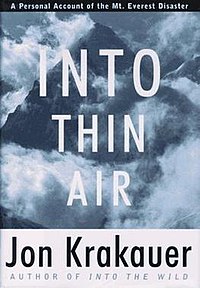
Into Thin Air - Jon Krakauer


Rating: 5 stars


Into Thin Air has been sitting on my shelf for at least a few years now, bought shortly after I'd completed Into the Wild, and left to the wiles of the dubious To Be Read pile. A conversation within Twitter's #fridayreads thread in which I stated, "I need to read more Krakauer," to another user, prompted me to pluck this out of the pile on his recommendation. I had told him that Into the Wild left, "such an impression on me." While having no doubt that Into Thin Air would display Krakauer's extraordinary talent as a journalist and writer - I still was skeptical that it could surpass Into the Wild in my heart and mind.

It has.

Similar to the start of Wild - Krakauer begins Thin Air about 3/4 of the way through his story. Before you even get moving, he's already shown you what is to come. You would think that this would help stall the shock and overwhelming emotion as in each chapter Krakauer and his teammates climb higher and higher to the summit of Everest. It doesn't. Not at all.

The book is Krakauer's personal account of the Everest tragedy in 1996. Sent on assignment by Outside magazine to report on the commercialization of the mountain, Krakauer and several, several others are caught up in a storm near the top of the mountain where they all faced severe hypothermia, hypoxia, and - for eight climbers - death. The story is harrowing tale of the beautiful danger of nature, survival against all odds, and - ultimately - the struggle to come to terms with leaving others behind. Krakauer leads us up the mountain, working hard to capture every detail, to accurately represent what he can and fill the gaps with as balanced speculation as possible.

Most amazingly, Krakauer manages to bring each of the people on that mountain to life again. I began to feel like they were people that I'd met - and when the inevitable tragedy struck, I found myself shaken to my core at their deaths. Throughout my day, I kept going back to the internet to search for their faces. To  continue to try and connect with people long gone, who weren't even mine to know.  Now - having finished - I am grieving.

Another interesting read: Paul Deegan's 1998 review of Anatoli Boukreev's "rival" book, The Climb. Though other supplemental reading suggests that the two were not enemies, persay, they did have different opinions on what happened that day. Krakauer writes Boukreev (a guide with the rival team) fairly poorly in Into Thin Air. 


Purchase Now from Amazon: Into Thin AirInto the WildThe Climb: Tragic Ambitions on Everest
Related Posts Plugin for WordPress, Blogger...